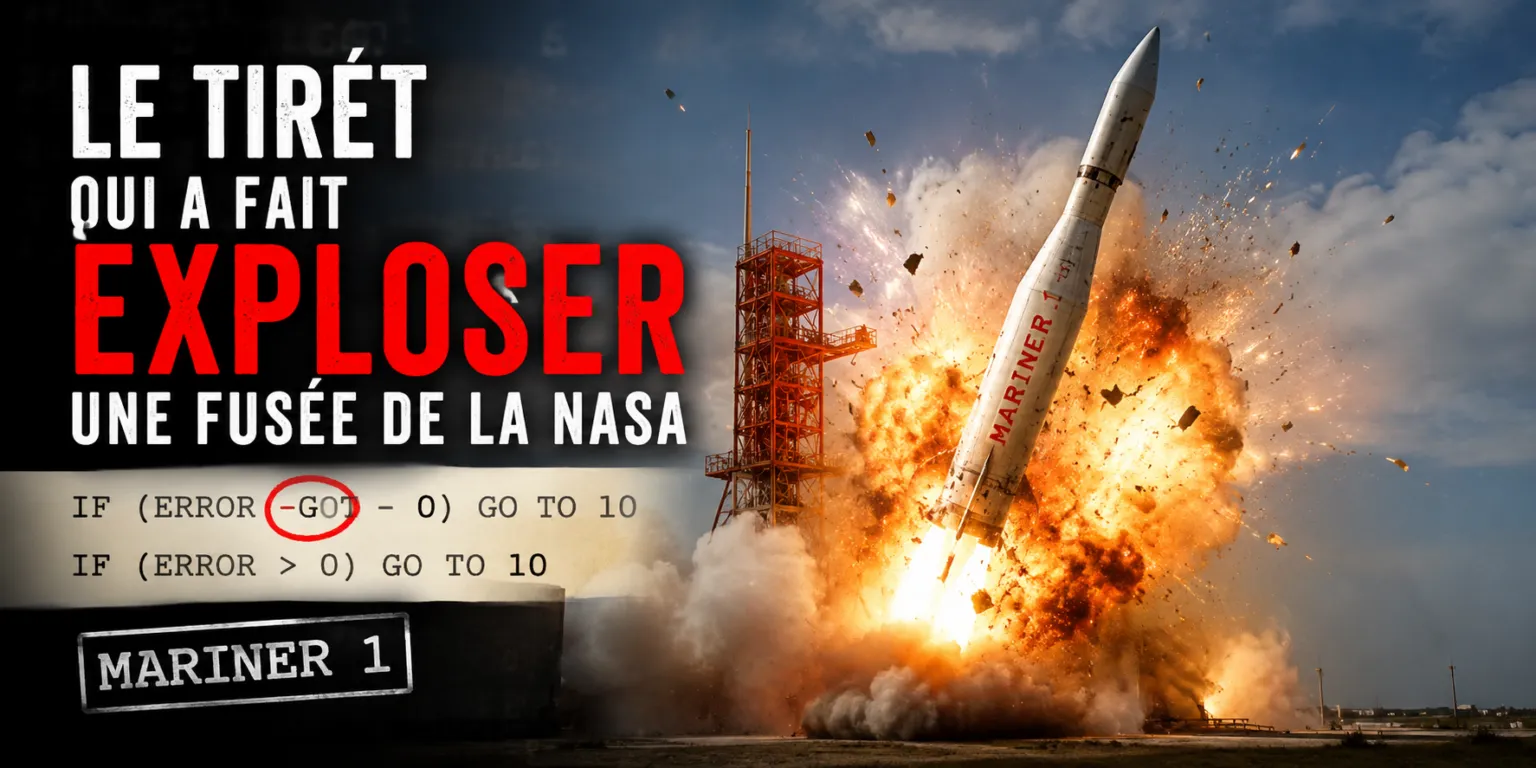
9:21 a.m., Cape Canaveral
On July 22, 1962, an Atlas-Agena rocket blasted off from the launch pad at Cape Canaveral. At its tip: Mariner 1, the very first American probe designed to fly by another planet. Its mission was simple on paper but breathtaking in reality: to reach Venus, observe it up close, and transmit data that no one on Earth had ever collected before.
We were in the thick of the space race. The Soviets had already launched Sputnik in 1957 and sent Gagarin into orbit in 1961. A year earlier, Kennedy had promised to land a man on the Moon before the end of the decade. Every launch counts; every success tips the scales. Mariner 1 is meant to restore the United States’ lead.
The launch proceeds normally. Then, about 290 seconds after liftoff, the rocket begins to veer erratically off course. The ground safety officer, fearing a crash in the North Atlantic shipping lanes or, worse, in a populated area, had only a few seconds to act. He initiated the destruction of the spacecraft. Mariner 1 explodes in mid-air, 293 seconds after leaving the launch pad.¹
Cost of the operation: approximately $18.5 million at the time, equivalent to about $180 million today².
The Investigation: A Overlooked Warning
In the days that followed, engineers at NASA and the Jet Propulsion Laboratory (JPL) combed through every line of code and every equation in the guidance system. The verdict came fairly quickly: the post-flight investigation committee identified the omission of an overbar (a bar above a letter) when transcribing a handwritten mathematical formula into the onboard computer code.³
Specifically, this symbol indicated that a velocity value needed to be smoothed—that is, calculated as an average across multiple measurements—to prevent the system from reacting to every minute variation. Without this symbol, the software treated perfectly normal fluctuations in the radar signal as actual trajectory deviations that needed to be corrected immediately. As a result, the rocket began to zigzag in response to variations that did not actually exist, until it became uncontrollable.
Five days later, the New York Times ran the front-page headline: “For Want of a Hyphen, Venus Rocket is Lost.” Science fiction writer Arthur C. Clarke, in his book *The Promise of Space* (1968), summed up the incident with a phrase that would endure for decades: Mariner 1 was destroyed by what he called “the most expensive hyphen in history” 4.
What the story simplifies (and why it matters)
Here’s the twist that the legend often leaves out: it wasn’t really a hyphen, nor was it the sole cause of the failure.
It wasn’t a hyphen. The official report from the NSSDCA (NASA’s Scientific Archives Center) explicitly refers to a missing overbar, not a hyphen.³ But “hyphen” was undoubtedly easier to explain to the public—and to journalists—who didn’t know what an overbar was. The image spread more widely than the technical reality, and it became ingrained in the collective memory.
That wasn’t the only cause. The official report is very clear on this point: the failure resulted from a combination of two factors.³ First, a hardware problem: the onboard radio beacon system on the rocket was malfunctioning, causing several interruptions in the velocity signal transmitted to the ground. Only then did the software bug come into play: during these interruptions, the guidance computer was supposed to switch to backup data, and it was precisely at that point that the absence of the smoothing hyphen transformed a manageable hardware problem into an uncontrollable trajectory.
In other words, the “missing dash” did not cause the accident on its own: it prevented the system from compensating for an initial, more mundane problem involving faulty hardware. The two failures combined sealed Mariner 1’s fate.
The Comeback: Mariner 2
NASA had built Mariner 1 and its twin in parallel, precisely to guard against this kind of scenario. The engineers corrected the code, rechecked the entire system, and launched Mariner 2 just 36 days later, on August 27, 1962. On December 14 of that same year, Mariner 2 became the very first spacecraft in history to successfully make a close flyby of another planet, confirming in the process that Venus is a scorching inferno and not the tropical ocean that some scientists still imagined at the time.
The failure of Mariner 1 thus became a footnote almost immediately, overshadowed by the success of its twin. All that remains today is Clarke’s quote—and a lesson that remains relevant to this day.
Why This Story Still Resonates with Today’s Computer Science
In 1962, the guidance system’s code did not exist natively in digital form: equations handwritten by mathematicians had to be transcribed, symbol by symbol, by engineers, and then coded. No systematic cross-checking, no automated verification tools, no version history. A single human being, a single sheet of paper, a single missed symbol—and no one to notice it before launch.
It’s hard not to see a very direct parallel with current software development practices: code reviews by multiple pairs of eyes, automated testing, continuous integration, and version control systems like Git exist precisely so that a human transcription error, no matter how tiny, never becomes the sole line of defense between a project and its destruction. Mariner 1 is not just an amusing historical curiosity: it is one of the first documented examples of a principle that, more than sixty years later, remains at the heart of software engineering—in a complex system, the cost of an error is never proportional to its size.